In the world of heavy industry and modern transportation, power is nothing without control and transmission. Gearboxes and transmission systems serve as the critical mechanical bridge between a power source—like an engine or an electric motor—and the driven machinery. These highly complex, tightly sealed units are engineered to handle immense torque, extreme rotational speeds, and relentless mechanical stress.
However, because these precision components are completely enclosed within heavy cast-iron or aluminum housings, they function as "black boxes." When a mechanical issue begins to develop deep inside the gear train, it remains entirely invisible to maintenance teams until it manifests as catastrophic vibration, howling noises, or total mechanical failure.
Historically, diagnosing a suspected transmission fault required a complete system teardown. This process is not only financially draining but also causes severe operational downtime. Today, the integration of advanced industrial borescope technology has fundamentally changed mechanical maintenance. By offering high-definition, non-destructive visual access into the heart of the machinery, gearbox and transmission inspection has become a proactive, data-driven science. This comprehensive guide explores the critical importance of internal diagnostics and how MAIYIS industrial vision solutions empower professionals to safeguard their most vital mechanical assets.
Why Gearbox and Transmission Inspection Is Critical in Mechanical Systems
A transmission system is only as reliable as its weakest gear tooth or bearing. Across virtually every heavy-duty sector, the gearbox is the core power transfer component:
Automotive Transmissions: Managing the complex shifting dynamics in passenger cars, commercial trucks, and the high-torque environments of Electric Vehicles (EVs).
Industrial Gearboxes: Driving massive conveyor belts, rock crushers, and assembly line machinery in continuous-production factories.
Wind Turbine Gear Systems: Converting the slow rotation of wind blades into the high-speed rotation required by generators, often located hundreds of feet in the air.
Marine Propulsion Systems: Transferring massive diesel engine power to ship propellers under relentless ocean conditions.
The absolute necessity of routine gearbox inspection stems from the inherent risks of internal, hidden wear and tear. A minor misalignment or a slightly degraded bearing does not immediately stop the machine. Instead, it creates a cascading effect of mechanical destruction.
Without visual inspection, lubrication failure goes unnoticed until the gears literally melt together. Microscopic metal debris accumulation acts like liquid sandpaper, accelerating wear across every moving part. Routine internal diagnostics using a transmission inspection camera allow maintenance teams to catch these anomalies in their infancy, preventing a $500 bearing replacement from turning into a $50,000 total gearbox failure.
Common Problems Found in Gearbox / Transmission Systems
When a technician guides a borescope into a gearbox, they are looking for specific forensic evidence of mechanical stress. Here are the most critical internal issues diagnosed during an industrial gearbox inspection:
Gear Tooth Wear and Pitting
Gears transfer power through direct metal-to-metal contact, separated only by a microscopic film of oil. Under extreme torque, surface fatigue occurs. This manifests as "micropitting" on the gear teeth—tiny craters that eventually merge into large spalling damage. As the friction damage increases, the gear profile changes, leading to severe efficiency loss, excessive noise, and eventual tooth shearing.
Lubrication Oil Contamination
Oil is the lifeblood of any transmission. However, as gears naturally wear, microscopic metal particles shear off and mix with the oil. If the filtration system fails, this metal-laden oil circulates through the gearbox. A borescope can easily identify dark, sludgy degraded lubrication performance and metallic glitter suspended in the oil, which rapidly destroys bearings and synchronizers.
Bearing Damage and Overheating
Bearings support the massive rotational loads of the gear shafts. When a bearing begins to fail due to lubrication starvation or thermal stress failure, the internal rollers and races become scored and discolored (often turning a dark blue or purple due to extreme heat). This damage causes abnormal vibration that can literally shake a gearbox apart if left unaddressed.
Misalignment and Structural Deformation
Improper installation, foundation settling, or sudden shock loads can cause the internal shafts to fall out of perfect alignment. This misalignment forces the gear teeth to mesh at incorrect angles, creating intense localized pressure. Long-term mechanical stress from misalignment leads to structural deformation of the casing and rapid, uneven gear wear.
Quick Reference: Gearbox Defect Matrix
| Gear Wear / Pitting | Friction & Surface fatigue | Efficiency loss & Noise | High |
| Oil Contamination | Metal debris / Poor filtration | Accelerated system failure | Critical |
| Bearing Damage | Overheating / Overloading | Severe vibration & Shutdown | High |
| Misalignment | Improper installation / Shock | Uneven wear & Stress | Medium to High |
How Gearbox / Transmission Inspection Works with Industrial Borescope
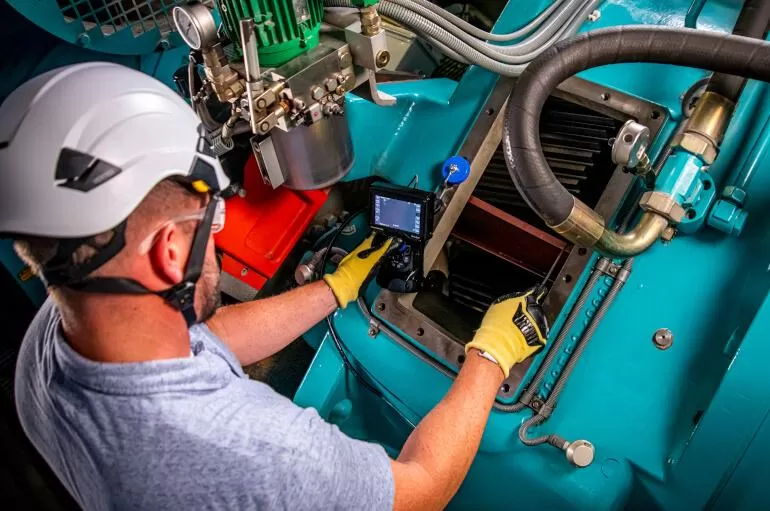
Conducting an internal inspection of a sealed gearbox requires precision and the right technology. Utilizing a specialized transmission inspection camera allows technicians to perform a surgical diagnostic procedure without breaking the primary casing seals. Here is the step-by-step workflow:
Step 1: Access Inspection Port or Housing Opening
The technician locates a non-invasive entry point. This could be an oil fill port, a dipstick tube, a breather vent, or a dedicated maintenance opening. Borescope probes are designed to be extremely thin, allowing them to slip through access points as small as 4mm to 6mm.
Step 2: Insert Flexible Borescope Probe
Once the port is open, the technician carefully feeds the flexible probe into the dark, oil-coated environment. Using an articulating (steerable) camera tip, the operator can navigate inside the gearbox, snaking past spinning shafts and structural baffles to reach the targeted gear assembly.
Step 3: Real-Time Internal Visualization
The dark interior of the gearbox is instantly flooded with light from the probe's ultra-bright LED illumination system. The HD imaging system captures the internal surfaces, transmitting a crystal-clear, live video monitoring feed to the technician's handheld screen.
Step 4: Identify Defects and Abnormal Wear
Acting as a mechanical detective, the technician visually sweeps the gear faces, searching for pitting, rust, or broken teeth. They inspect the roller bearings for signs of overheating and evaluate the bottom of the casing for thick sludge or metal shaving accumulation.
Step 5: Record Data for Maintenance Decisions
Professional diagnostics require undeniable evidence. The borescope allows for high-definition video recording and photo capture. This data is extracted to generate comprehensive diagnostic reporting, which empowers plant managers to execute predictive maintenance planning rather than reacting to sudden emergencies.
Applications of Gearbox / Transmission Inspection
Because torque and power transfer are universal requirements, the need for industrial gearbox diagnostics spans across virtually every heavy-duty sector.
Automotive Transmission Systems
In the automotive world, mechanics use borescopes to diagnose automatic transmission clutch pack failures in passenger vehicles, inspect the extreme-stress racing gearboxes of motorsports vehicles, and evaluate the high-RPM, compact EV transmission units that drive modern electric cars.
Industrial Machinery Gearboxes
Manufacturing plants rely on gearboxes to keep factory production lines moving. Technicians routinely inspect the heavy equipment gear drives used in mining, cement milling, and steel production, ensuring that continuous-operation machinery does not suffer sudden, catastrophic lockups.
Wind Turbine Gear Systems
Wind energy presents a unique challenge: the gearbox sits inside a nacelle 300 feet above the ground. Tearing down a wind turbine gearbox requires massive, expensive cranes. Therefore, offshore wind farms rely heavily on borescope condition monitoring to spot gear fatigue early, allowing them to schedule repairs during low-wind seasons.
Marine Propulsion Systems
A gearbox failure in the middle of the ocean is a life-threatening scenario. Marine engineers utilize long-reach borescopes to inspect massive ship engine gearboxes and the propulsion drives of offshore vessels, ensuring absolute reliability before embarking on long voyages.
Recommended MAIYIS Solutions for Gearbox / Transmission Inspection
Standard commercial inspection cameras will quickly fail when exposed to the harsh, chemically aggressive synthetic oils found in modern gearboxes. MAIYIS has engineered a robust product line of industrial-grade diagnostic tools specifically designed to thrive in these severe mechanical environments.
Industrial Borescope for Deep Gearbox Inspection
Best For: Heavy-duty gearbox systems, wind turbines, and large-scale industrial machinery.
Key Features: This flagship system is built for extreme environments. It features high-resolution imaging to spot microscopic gear pitting, combined with a highly flexible insertion probe. Crucially, it boasts a strictly engineered oil-resistant design (IP67/IP68), ensuring the camera lens and insertion cable will not degrade when submerged in harsh industrial gear lubricants.
Handheld Pipeline Inspection System for Maintenance Teams
Best For: Automotive workshop technicians and on-site gearbox diagnostics in factories.
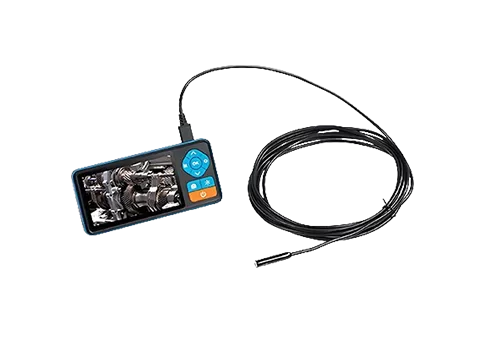
Key Features: Designed for the mechanic on the move. This all-in-one portable design integrates the camera, articulation controls, and an HD display into a single unit. It allows for incredibly fast deployment—a technician can pull it from their toolbox and diagnose a transmission fault in minutes without setting up external monitors.
Endoscope Camera Module for System Integration
Best For: OEM monitoring systems and automated inspection platforms.
Key Features: For manufacturers looking to build permanent condition-monitoring solutions into their machinery, MAIYIS offers an embedded vision system. This bare-bones, highly adaptable module is industrial integration ready. Its customizable design allows engineers to integrate the camera directly into the gearbox casing for continuous 24/7 visual monitoring.
Benefits of Using Borescope for Gearbox Inspection
Transitioning from a reactive, "run-to-failure" maintenance strategy to proactive visual inspection yields immediate, measurable financial returns.
Key Advantages Include:
No Gearbox Disassembly Required: Keep the housing sealed. Inspect the gears while the unit remains fully installed on the production line or in the vehicle.
Early Detection of Internal Damage: Spotting a micro-crack today prevents a shattered gear tomorrow.
Reduced Downtime: What used to take a week of mechanical teardown now takes 30 minutes of visual inspection.
Lower Maintenance Cost: Replace only the specific bearing or gear that is failing, rather than rebuilding the entire unit.
Improved Predictive Maintenance Capability: Trend the wear of a gear tooth over time through recorded videos, predicting exactly when it will need replacement.
Comparison: Traditional Teardown vs. Borescope Inspection
| Full Disassembly | Extremely High | Days to Weeks | High | Severe |
| MAIYIS Borescope Inspection | Low | Minutes | High (Visual Proof) | Minimal to None |
How to Choose the Right Gearbox Inspection Equipment
Procuring the correct transmission inspection camera requires understanding the specific constraints of the mechanical systems you service. Consider these critical factors before making a purchasing decision:
Oil Resistance Capability: This is the most critical factor. The probe must be chemically resistant to highly caustic synthetic gear oils and automatic transmission fluids (ATF).
Probe Flexibility and Diameter: The probe must be thin enough to enter small oil ports (under 6mm) and flexible enough to snake through complex planetary gear sets.
Camera Resolution (HD/4K): To spot hairline fatigue cracks on shiny, oil-coated metal, ultra-high resolution is absolutely necessary.
Lighting System Strength: Gearboxes are pitch-black cavities absorbing light. Powerful, adjustable LED illumination or fiber-optic lighting is required.
Insertion Length: Automotive transmissions need short probes, while wind turbine gearboxes may require several meters of reach.
Data Recording Function: Ensure the device can easily capture and export video files for maintenance logs and client reports.
Why Choose MAIYIS for Gearbox / Transmission Inspection Solutions
When an incorrect diagnosis can result in a catastrophic mechanical failure and massive operational losses, professionals do not compromise on their tools. Global industries trust MAIYIS because we engineer our solutions based on uncompromising reliability and technological superiority.
Quality You Can Trust
Our borescopes are built upon precision engineering standards. We understand that these tools will be dropped on concrete floors, soaked in gear oil, and pushed into harsh environments. MAIYIS equipment is designed to deliver stable industrial performance and rock-solid product reliability day in and day out.
Innovation-Driven Technology
We are obsessed with advanced machine vision systems. Through continuous R&D innovation, MAIYIS consistently brings forward-looking inspection solutions to the market, integrating features like ultra-bright illumination, 3D measurement capabilities, and highly responsive joystick articulation for precise navigation.
Integrity and Long-Term Partnerships
We operate on a foundation of transparent collaboration. MAIYIS is dedicated to building a global B2B trust network with repair franchises, industrial plants, and distributors. We provide long-term technical support to ensure your inspection program remains cutting-edge.
Quality Control Excellence
To guarantee perfection, MAIYIS builds a full lifecycle QC system:
R&D Quality Assurance: Rigorous stress-testing of new probe materials in boiling oil and chemical baths.
Production Process Control: Meticulous calibration on the assembly line.
Final Delivery Validation: Every unit is tested for articulation fluidity and optical clarity before shipping.
Our ultimate goal: delivering zero-defect industrial vision solutions.
Social Responsibility Commitment
We believe that leading companies must be responsible corporate citizens. MAIYIS is committed to environmental sustainability, continuous employee development, strictly ethical manufacturing practices, and active community contribution.
MAIYIS Industrial Vision Solutions for Gearbox Inspection
Visualizing the internal health of a gearbox is the most powerful diagnostic capability a mechanical reliability engineer can possess. MAIYIS provides the clarity, durability, and precision required to keep the world's gears turning smoothly.
Explore MAIYIS Product Categories:
Industrial Borescope: Heavy-duty, articulating systems for complex gear and transmission diagnostics.
Endoscope Camera Module: Customizable imaging cores for OEM integration and condition monitoring.
Endoscope Application Solutions: Enterprise-grade diagnostic workflows for heavy industry.
Veterinary Endoscopes: Showcasing our deep, cross-industry imaging technology expertise.
Endoscope Building Inspection: Expanding the use of borescope systems into building diagnostics, enabling non-destructive inspection of structural cavities, ducts, and hidden infrastructure in modern facilities.
Frequently Asked Questions (FAQ)
Q: Will synthetic gear oil or transmission fluid damage the borescope camera?
A: No. MAIYIS industrial borescopes designed for mechanical inspection are built with specialized oil-resistant polymers and feature IP67/IP68 waterproof ratings. They can be safely submerged in synthetic gear oils, ATF, and hydraulic fluids without degrading the lens or the insertion tube.
Q: Can the camera navigate through the complex gears of an automatic transmission?
A: Yes. Our advanced borescopes feature steerable, articulating camera tips. Using a joystick on the handle, the technician can bend the camera up to 180 degrees in multiple directions, allowing it to weave through planetary gear sets, clutch packs, and internal baffles.
Q: How small of an opening do I need to inspect a gearbox?
A: MAIYIS offers a variety of probe diameters to suit different applications. Our ultra-thin probes (as small as 4mm or 5.5mm) are specifically designed to slide effortlessly through standard oil dipstick tubes, breather vents, or tiny sensor ports, eliminating the need to drill holes or remove casing covers.
Q: Can I record the inspection to show my client or plant manager?
A: Absolutely. Visual proof is critical for justifying maintenance costs. MAIYIS borescopes feature built-in DVR capabilities, allowing you to capture high-definition photos and record real-time inspection videos directly to an SD card or connected smart device for easy report generation.